Showing posts with label Digital Mobile Radio. Show all posts
Showing posts with label Digital Mobile Radio. Show all posts
Amateur radio is
Amateur radio is ::
Amateur radio is a hobby with so many aspects it can be hard to describe – and difficult to know what to try first! We’ve tried to give a taster of just some of the many exciting, challenging and fun things you can do with amateur radio. We’re planning to take a look at other parts of the hobby in the future - what's your favourite?

Sexism in Ham Radio
I started this
blog posting pretty late one evening, but I decided my comments are strong enough that I
would like the HAM community to read them as a main post instead of having
them buried, and am tipsy enough to say what I really think.

Well hi there, Ham Radio opers, apparently we haven't met because you see no difference between me and a hired actress who doesn't know the first thing she's talking about. I'm the woman on that cover. I have also been a proud Ham radio operator going on 14 years now, and credit my love for this hobby for why I'm now getting a PhD in radio astronomy. I am also a good operator- a few years ago I single handedly set the record for my category/division in Sweepstakes, for example, and have the plaque and mug to prove it. I would say that's a helluva good street cred to be on the cover of a Ham radio book, and you would have posted a picture if you were on it because you'd be proud of it too. It's a natural reaction. And if your first thought is "yeah, but she's a girl so

Well hi there, Ham Radio opers, apparently we haven't met because you see no difference between me and a hired actress who doesn't know the first thing she's talking about. I'm the woman on that cover. I have also been a proud Ham radio operator going on 14 years now, and credit my love for this hobby for why I'm now getting a PhD in radio astronomy. I am also a good operator- a few years ago I single handedly set the record for my category/division in Sweepstakes, for example, and have the plaque and mug to prove it. I would say that's a helluva good street cred to be on the cover of a Ham radio book, and you would have posted a picture if you were on it because you'd be proud of it too. It's a natural reaction. And if your first thought is "yeah, but she's a girl so
How to handle a nasty HAM radio operator
We've all run across them, the sarcastic voice with a kilowatt behind it
who spews negativity. They often hang together on a specific frequency
and aren't above attacking a newbie who isn't operating exactly as they
would like. What are some effective strategies for dealing with mean
people on the air?
Riley Hollingsworth
Riley Hollingsworth K4ZDH spent 10 years as the lead enforcement agent for Amateur Radio at the FCC before he retired in 2008. He was effective, personable, and as you'll see in this talk at the Dayton Hamvention® in 2007... FUNNY. This is really a stand-up comedy routine. I've titled it 'One Big Knob."
Of course, he's making a point. One that we all know already, but clearly need to be reminded of from time to time. I talked with Riley later that day, and he asked if this departure from the standard "Enforcement Update" was the right thing to do. Well, see for yourself.
Canadian 🇨🇦 Amateur Radio Discussion ::
https://groups.io/g/HAMRadioCanada
Riley Hollingsworth K4ZDH spent 10 years as the lead enforcement agent for Amateur Radio at the FCC before he retired in 2008. He was effective, personable, and as you'll see in this talk at the Dayton Hamvention® in 2007... FUNNY. This is really a stand-up comedy routine. I've titled it 'One Big Knob."
Of course, he's making a point. One that we all know already, but clearly need to be reminded of from time to time. I talked with Riley later that day, and he asked if this departure from the standard "Enforcement Update" was the right thing to do. Well, see for yourself.
Canadian 🇨🇦 Amateur Radio Discussion ::
https://groups.io/g/HAMRadioCanada
Amateur Radio the gender imbalances in Ham radio, and why I will no longer use the term YL
I've had a bit of time to think about this lately, and hopefully enough time has passed since a certain other thread that we can avoid the baggage from there.
Ham radio has a gender problem. In the USA, it's about 15% women, but in my personal experience I feel there are far fewer active operating Hams who are female for whatever reason (for example, I logged a few hundred voice QSOs during the last Field Day, and it was definitely under 5% female). As a woman who got her license at 16 and has been active in this hobby for over a decade, plus one who is fairly visible in various ways in the hobby, a lot of people have asked me my thoughts on this. And to be clear, these are just my thoughts, and you're free to chime in on whether you agree or disagree with any of them.

Basically, for me the crux of it comes down to is Ham radio is not terribly good at making women feel like they belong in the field. What I mean about this is I have long ago lost count how many patronizing comments I got in QSOs and "creepy old guy" comments, and even though I lived really near Dayton for nearly all of the first decade I was licensed, I never went because I didn't think I'd enjoy a weekend of men staring at me. (You can argue this wouldn't have been the case, but it was my experience at local Hamventions and club meetings, which is why I guess I've never really attended either.) And, to be clear, I have many male dominated hobbies and work in a male dominated field- also, interestingly, estimated to be around 15% women- and honestly
nothing has make me feel like I don't belong quite as much like Ham radio. (I also hate to say it, but as a top 100 Reddit commenter you know who has sent me by farthe most hate mail and ad hominem attacks? /r/amateurradio users. Cheers guys! I figure if I'm making you mad, I'm doing something right!)
Once again, people are free to voice what they think about this, and I realize this isn't going to change overnight. But thinking about it, one obvious example example of this to me is the fact that in Ham radio we still commonly use YL, ie "young lady," to refer to all women regardless of age. I will freely admit that this didn't annoy me much when I was a young woman, but by now I am 30 years old and am going to have a doctorate in astrophysics by the end of the year (hopefully). And being called a YL is starting to feel really patronizing and condescending to me, in a way related to calling a grown man "boy." It definitely has been said to me many times in a way that does not make me feel like just another Ham radio operator.
As such, starting today I am no longer referring to myself or anyone else as a YL, and encourage other Hams to do the same. Fair warning, I'm toying with sending an article to QST on this too and will take what the comments here say into consideration for anything I write (if I do: see that dissertation due this year thing).
Ham radio has a gender problem. In the USA, it's about 15% women, but in my personal experience I feel there are far fewer active operating Hams who are female for whatever reason (for example, I logged a few hundred voice QSOs during the last Field Day, and it was definitely under 5% female). As a woman who got her license at 16 and has been active in this hobby for over a decade, plus one who is fairly visible in various ways in the hobby, a lot of people have asked me my thoughts on this. And to be clear, these are just my thoughts, and you're free to chime in on whether you agree or disagree with any of them.

Basically, for me the crux of it comes down to is Ham radio is not terribly good at making women feel like they belong in the field. What I mean about this is I have long ago lost count how many patronizing comments I got in QSOs and "creepy old guy" comments, and even though I lived really near Dayton for nearly all of the first decade I was licensed, I never went because I didn't think I'd enjoy a weekend of men staring at me. (You can argue this wouldn't have been the case, but it was my experience at local Hamventions and club meetings, which is why I guess I've never really attended either.) And, to be clear, I have many male dominated hobbies and work in a male dominated field- also, interestingly, estimated to be around 15% women- and honestly
nothing has make me feel like I don't belong quite as much like Ham radio. (I also hate to say it, but as a top 100 Reddit commenter you know who has sent me by farthe most hate mail and ad hominem attacks? /r/amateurradio users. Cheers guys! I figure if I'm making you mad, I'm doing something right!)
Once again, people are free to voice what they think about this, and I realize this isn't going to change overnight. But thinking about it, one obvious example example of this to me is the fact that in Ham radio we still commonly use YL, ie "young lady," to refer to all women regardless of age. I will freely admit that this didn't annoy me much when I was a young woman, but by now I am 30 years old and am going to have a doctorate in astrophysics by the end of the year (hopefully). And being called a YL is starting to feel really patronizing and condescending to me, in a way related to calling a grown man "boy." It definitely has been said to me many times in a way that does not make me feel like just another Ham radio operator.
As such, starting today I am no longer referring to myself or anyone else as a YL, and encourage other Hams to do the same. Fair warning, I'm toying with sending an article to QST on this too and will take what the comments here say into consideration for anything I write (if I do: see that dissertation due this year thing).
Best starter HF transceiver
Best starter HF transceiver
What's a good starter HF transceiver, simple to operate, maybe the earliest model of Icom or Kenwood or any other brand that first came out with the built in antenna tuner, from $250 to $400 price range.
Answer :
First you need to decide what type of operating and modes you want. Digital requires more stability, CW is a lot simpler, etc. Once you define that, then I think it will be a lot easier to define what you would like.
Answer :
Although it's older technology, the Kenwood TS-130 is dead simple to operate, and can be found fairly inexpensively (less than $250). A TS-120 is also cool if you don't mind losing the WARC bands.... The Icom IC-718 is also popular, but will run you just a bit more (around $400 used, depending on the installed options).
Neither of these rigs have a built in tuner, but that's okay. You're better off with an outboard tuner. Most on-board tuners have a very limited tuning range (usually only about 3:1). That's enough for trimming a single band dipole, but not much more. An outboard tuner will match 10:1 or better, so you get a lot more tuning solutions.
I own both radios, and their both decent performers. I think the 130 has better ears, although the 718 has better specs. I've gotten good comments on the audio from both rigs, but I performed a simple mod to the Icom mic to make it sound better. The Icom is more feature-rich than the Kenwood, but is still relatively easy to use. Mine has the optional TCXO installed,
Neither of these rigs have a built in tuner, but that's okay. You're better off with an outboard tuner. Most on-board tuners have a very limited tuning range (usually only about 3:1). That's enough for trimming a single band dipole, but not much more. An outboard tuner will match 10:1 or better, so you get a lot more tuning solutions.
I own both radios, and their both decent performers. I think the 130 has better ears, although the 718 has better specs. I've gotten good comments on the audio from both rigs, but I performed a simple mod to the Icom mic to make it sound better. The Icom is more feature-rich than the Kenwood, but is still relatively easy to use. Mine has the optional TCXO installed,
CQMM DX Contest 2015 Result
CQMM DX Contest 2015 Result
Release of full results of CQMM DX Contest 2015. Congratulations for all 978 participants from 112 DXCC entities took part of this competition sponsored by CWJF Group. Database shows 143,538 QSOs from all Continents. During cross checking log process, we could validate about 96% of QSOs among over 8,024 callsigns listed on all the received logs. We are very happy with world wide response to CQMM DX Contest. We hope have you again on the contest next year.If you need more information about results, please contact us by email: help@cqmmdx.com
CONGRATS to the following :
VE2FK, VE1DT, VE3KZ, VE6UM, VA7ST, VA7MM, VA3FN, VE7JKZ
| Callsign | Operator | Band | Power | 80M | 40M | 20M | 15M | 10M | Total | Mults | Claimed Score | Final Score | Reduction | Club |
|---|---|---|---|---|---|---|---|---|---|---|---|---|---|---|
| PW2F | SINGLE-OP | ALL | HIGH | 7 | 136 | 404 | 432 | 635 | 1614 | 291 | 1,763,751 | 1,697,985 | -3.73% | ARAUCARIA DX GROUP |
| 9A7R | SINGLE-OP | ALL | HIGH | 15 | 225 | 286 | 466 | 152 | 1144 | 264 | 1,293,200 | 1,225,488 | -5.24% | CROATIAN CONTEST CLUB |
| PY9MM | SINGLE-OP | ALL | HIGH | 0 | 93 | 266 | 358 | 400 | 1117 | 242 | 1,031,695 | 983,488 | -4.67% | RIO DX GROUP |
| PQ5FB | SINGLE-OP | ALL | HIGH | 2 | 129 | 222 | 258 | 409 | 1020 | 245 | 958,607 | 911,645 |
What is the WIN System ?
The WIN System is an OPEN System of hams enjoying our wide area linked (or intertied) repeater system covering most of California. The WIN System was designed and built by Shorty, K6JSI, with a lot of help from the WIN System membership! Shorty owns all the repeaters and equipment that carry his call sign. The WIN System has crystal clear audio, which is probably one of the first things you noticed when you began listening to the WIN System.
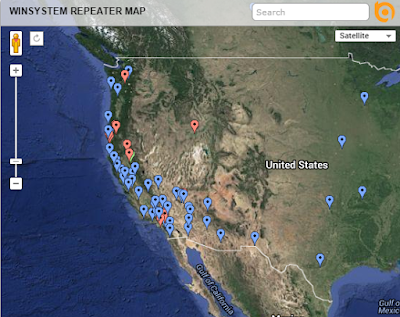 The WIN System is a series of 71
linked, or Intertied repeaters, most are 440, or UHF repeaters, but we
have some 2-meter and 220 repeaters as well, that cover a great deal of
California, 16 States, and four Countries around the world. The WIN
System is owned and operated by Shorty, K6JSI,
with a lot of help from the faithful WIN
System membership.
The WIN System is a series of 71
linked, or Intertied repeaters, most are 440, or UHF repeaters, but we
have some 2-meter and 220 repeaters as well, that cover a great deal of
California, 16 States, and four Countries around the world. The WIN
System is owned and operated by Shorty, K6JSI,
with a lot of help from the faithful WIN
System membership.
The membership is what makes the WIN System great! We are honored to have a very diverse cross-section of the ham radio community on our System. It makes for some very interesting conversation. Everything from technical talks to comedy can be heard on the WIN System.

The WIN System started in the San Diego area in 1990, and moved into the Imperial Valley/South-West Arizona area, then the Los Angeles area, then the Southern/Central San Joaquin Valley area.

The membership is what makes the WIN System great! We are honored to have a very diverse cross-section of the ham radio community on our System. It makes for some very interesting conversation. Everything from technical talks to comedy can be heard on the WIN System.

The WIN System started in the San Diego area in 1990, and moved into the Imperial Valley/South-West Arizona area, then the Los Angeles area, then the Southern/Central San Joaquin Valley area.
What is The Best HF HAM Radio Antenna
What is the best all around hf antenna you can get ??
Does "best" in this context mean the most expensive antenna available?
Does "best" in this context mean the easiest antenna to install?
Does "best" in this context mean you have unlimited space and the size of the antenna is not a factor?
Does "best" mean you are only concerned with performance?
Does "best" mean you are only concerned with how many bands the antenna will function?
Does "best" mean you have a 90 foot tower or does "best" mean you are limited to using 2 trees in the backyard?
...Do you see the problem with "best"?
AOR AR-DV1 Wideband Communications Receiver
AOR AR-DV1 Wideband Communications Receiver
The DV1 is the first radio that provides decoding of many of the digital formats which no other scanner is able to receive, including:

- MotoTrbo ™
- DMR ™
- dPMR ™
- NXDN ™
as well as numerous amateur radio digital formats from Yaesu, Kenwood, Icom and Alinco. The radio will also decode APCO-25 Phase I digital as well as conventional analog traffic. (The receiver does not trunk). MotoTrbo systems are now used by public safety agencies and business around the country and the world. NXDN is used by public safety as well as railroads around the nation.
This radio is a huge breakthrough and we hope you’ll join us at Dayton this year to see the receiver in action, live at our booth. We also will have a small stock available for purchase at the show. Gommert Buysen of BuTel Software will once again be at our booth as well
ONLINE INTERNET ANONYMITY BOX PUTS YOU A MILE AWAY FROM YOUR IP ADDRESS

In the game of anonymity-versus-surveillance online, the discovery of the user’s IP address usually means game over. But if Ben Caudill has his way, a network snoop who successfully hunts a user through layers of proxy connections to a final IP address would be met
HAM Radio Morse Code
Morse Code
Main articles: morse code, Wikipedia:Morse codeMorse code is a way to encode text through the generation of a carrier wave (CW). It is used to communicate over long distances or with low power (QRP).
You do not need to learn morse code to obtain a radio license or operate an amateur radio station anymore.
The code is composed of 5 elements:
- short mark, dot or 'dit' (·) — one unit long
- longer mark, dash or 'dah' (–) — three units long
- intra-character gap (between the dots and dashes within a character) — one unit long
- short gap (between letters) — three units long
- medium gap (between words) — seven units long
| Character | Code | Character | Code | Character | Code | Character | Code | Character | Code | Character | Code |
|---|---|---|---|---|---|---|---|---|---|---|---|
| A | · — | J | · — — — | S | · · · | 1 | · — — — — | . | · — · — · — | : | — — — · · · |
| B | — · · · | K | — · — | T | — | 2 | · · — — — | , | — — · · — — | ; | — · — · — · |
| C | — · — · | L | · — · · | U | · · — | 3 | · · · — — | ? | · · — — · · | = | — · · · — |
| D | — · · | M | — — | V | · · · — | 4 | · · · · — | '' | · — — — — · | + | · — · — · |
| E | · | N | — · | W | · — — | 5 | · · · · · | ! | — · — · — — | - | — · · · · — |
| F | · · — · | O | — — — | X | — · · — | 6 | — · · · · | / | — · · — · | _ | · · — — · — |
| G | — — · | P | · — — · | Y | — · — — | 7 | — — · · · | ( | — · — — · | " | · — · · — · |
| H | · · · · | Q | — — · — | Z | — — · · | 8 | — — — · · | ) | — · — — · — | $ | · · · — · · — |
| I | · · | R | · — · | 0 | — — — — — | 9 | — — — — · | & | · — · · · | @ | · — — · — · |
HAM radio hamspeak
Amateur radio | HAM radio hamspeak
If you've heard somebody use terminology you're not familiar with, look it up here and you're likely to find the definition. If you don't find it, contact us and we will consider adding it to the list.
Search Tip: Use the "Find" feature of your browser to search for the occurrence of a particular word. Most popular browsers such as Microsoft's Internet Explorer and Netscape's Navigator allow you to access the "Find" feature by pressing Ctrl-F.
0-9|A|B|C|D|E|F|G|H|I|J|K|L|M|N|O|P|Q|R|S|T|U|V|W|X|Y|Z
| ? | "Slashed Zero" - distinguishes a ZERO from the letter "O". Intended to resolve ambiguity in callsigns like ""W?OF". Not needed for callsigns like "W0RK". Can be produced by pressing Alt?216 on your PC keyboard (Note: you must use the numeric keypad, not the numbers across the top row of the keyboard. This method should work in most PC-based editors such as e-mail clients, word processors, etc.) |
| 73 | "Best Regards" (Source: "Morse Code: The Essential Language", 2nd Ed., ARRL Publishing) |
| 807 | An old glass vacuum tube, several inches tall and around. Also, slang for a beer, as in "there's nothing like a cold 807 on a hot Arizona afternoon" (thanks to W7QY). According to our friends in Ireland, a pint of Guinness is known as a "Black 807" (thanks to GI4FUE). |
| 88 | "Hugs" and/or "Kisses" |
| ACSB | Amplitude Compandored Sideband modulation |
| AGC | "Automatic Gain Control"; a circuit in a radio which automatically adjusts the overall gain of the receiver |
| A-Index | Linear index for measuring the disturbance level in the earth's magnetic field. The index is defined over a period of one day (Courtesy of IPS Radio and Space Services, Sydney, Australia). |
| AM | "Amplitude Modulation"; slang often used is "Ancient Modulation" (courtesy of VE3FFK). |
| AMTOR | "Automatic Teleprinting Over Radio"; popular digital mode on HF |
| Antenna Gain | The ratio of the power required at the input of a loss-free reference antenna to the power supplied to the input of the given antenna to produce, in a given direction, the same field strength at the same distance (def. courtesy of Telecom Glossary 2000) |
| Antenna Party | A long-standing tradition among hams where several gather to assist a fellow ham in mounting antennas and/or towers. Often accompanied by malt consumables and lies AFTER the tower and the antennas are up and working...well, the consumables anyway (thanks to WD5CTQ). |
| AOS | "Acquisition of Signal" from a satellite; occurs when the satellite becomes "visible" to the antenna as it comes up from the horizon. |
| APRS | Automatic Packet Reporting System (Uses GPS + Packet Radio) |
| ARRL | "American Radio Relay League"; A U.S.-based organization which exists to support Amateur Radio. For more information, please visit http://www.arrl.org. |
| ATV | "Amateur
Television"; typically found on the 430 MHz and 1.2 GHz bands; see
http://www.hampubs.com/atv.htm for more information (thanks to KG4LXA for the suggested link).
|
Dstar vs Dmr rx only
You can make your own minds up from this, my icom 5100 is rx via raspi
the dp3600 is rx via gb7mb both work great , I would have done fusion
also but not a sausage on it up here ..a dead mode
Encryption and Amateur Radio
Why would anyone want to use encryption on ham radio? comment below.
That said, there has never been any expectation of privacy for communications under amateur license.
In Canada, from what Industry Canada has said, it is legal to use encryption on the amateur frequencies as long as you use a key that is published. If you don't make the key available to everyone, you can't encrypt.
Interesting how Canada and the US are different on encryption in the ham bands. What's ironic, is that if the encryption key is publicly available to anyone/everyone, doesn't that negate the purpose of encryption? That's like putting a sign on your front door that says "Door is locked so that no one may enter. There is a spare key under the door mat. Come on in."
Since Amateur Radio is not designed to be a private means of communication, why would anyone need/want to use encryption in the ham bands, except for experimentation? No answer needed, that was a rhetorical question, and one that has been beaten to death.
Conventional frequencies - Toronto County Ontario - Amateur Radio
Conventional frequencies
Toronto County Ontario - Amateur Radio
Top 5 Ham Radio Transceiver Base Stations
Hams, also known as amateur or Ham radio operators, use radio transceivers to communicate with each other and provide emergency notification services. Although the continual advancement in technology has made the need of radio transceivers obsolete, many continue to use the device for the purpose of hobby. Once considered expensive equipment, ham radio transceiver base stations can now be purchased through more affordable means, making them ideal for those interested in this leisurely activity. When purchasing a ham radio transceiver base station at retailers such as eBay, buyers should consider the various types of broadcasting and familiarize themselves with the top five ranked models available based on consumer standards.
Types of Broadcasting
Ham radio transceiver base stations use either digital, analog, or a combination of both to broadcast signals. Buyers should consider the benefits and drawbacks of each as well as location when choosing the type that best suits their personal needs and wishes.
Digital Ham Radio Transceiver Base Stations
A digital ham radio transceiver base station uses digital technology, as opposed to analog. These transceivers allow for additional modes including digital radio teletype (RTTY), voice over IP (VOIP), and TCP/IP-based packet radio. Digital modes have replaced older radiotelegraphy methods. For example, RTTY has taken the place of Morse code, allowing users to communicate non-verbally over the radio.
Digital ham radios also offer stronger signals and better adaptability to changing weather conditions, over that of analog ham radios. In addition, they are easier to operate and offer increased reliability to users. Digital ham radios can converse and hold multi-person conversations from various regions of the world over radio waves. They can also use signal repeaters and other tactics such as bouncing signals off the Northern Lights, to communicate with operators as far away as space. This allows astronauts occupying the International Space Station to remain in contact with those here on earth.
Analog Ham Radio Transceiver Base Stations
Analog ham radio transceiver base stations use a mechanical system. These radios offer increased stability in regards to power consumption. This is important, especially in the midst of emergencies when the ham radio needs to be able to run off the grid, with limited resources. Adding a computer to the ham radio increases power usage, which is often limited during states of emergency.
Digital and Analog Ham Radio Transceiver Base Stations
Digital and analog ham radio transceiver base stations can handle both digital and analog signals. These transceivers are ideal is regions where digital coverage is inconsistent as they ensure that there is no loss of signal. Digital and analog transceiver base stations are often more expensive because of their need to factor in additional electrical circuits.
Top Five Radio Transceiver Base Stations
With all the ham radio transceiver base stations available on the consumer market, it can be difficult deciding which models are a worthwhile investment. The following top five transceivers have received consistent positive reviews and have gain popularity based on their high performance standards and ease of use.
Canadian DRAM Class Action
You can get $20 or more by completing a claim form! Find out about the DRAM class action:
Canadian DRAM Class Action
Canadian DRAM Class Action How every single Canadian can get a free $20, no questions asked
- All you have to do is head online to The Money is Mine and fill out a simple form. ...
https://www.themoneyismine.ca/
Canadian DRAM Class Action
Canadian DRAM Class Action How every single Canadian can get a free $20, no questions asked
- All you have to do is head online to The Money is Mine and fill out a simple form. ...
https://www.themoneyismine.ca/
Amateur Radio Clubs - Ontario South Region
Amateur Radio Club
Below is a list of Ontario South Region Amateur Radio Clubs.
http://torontofrequency.blogspot.com/
Below is a list of Ontario South Region Amateur Radio Clubs.
http://torontofrequency.blogspot.com/
My $50 entry level ham kit
An often seen post around here is "how do i get into the hobby on the
cheap." in fact, just this past week i posted a similar question. I'll
include a link to that below.
I thought it would be good to post back and document a little of my process and how I ultimately made my decision.
The sheer amount of possible activities under the "ham umbrella" is intimidating. On top of that, there is a huge amount of equipment with a mind-boggling amount of features and modes and frequencies/bands. If your coming into the hobby on a budget your likely very concerned that you'll end up buying the wrong gear for what you want to do and it'll end up in a closet somewhere as a busted hobby.
First thing I did was start researching all the different activities. I made a list of all the things i wanted to do with ham radio. CW, ads-b, QRP DX, home-brew radios and antennas, etc. I sorted these lists by the licenses it would require, as well as the cost/complexity of the equipment required. For example, rx-only from a local UHF/VHF repeater requires significantly less complicated and costly equipment than DX'ing on the super low bands.
I thought it would be good to post back and document a little of my process and how I ultimately made my decision.
The sheer amount of possible activities under the "ham umbrella" is intimidating. On top of that, there is a huge amount of equipment with a mind-boggling amount of features and modes and frequencies/bands. If your coming into the hobby on a budget your likely very concerned that you'll end up buying the wrong gear for what you want to do and it'll end up in a closet somewhere as a busted hobby.
First thing I did was start researching all the different activities. I made a list of all the things i wanted to do with ham radio. CW, ads-b, QRP DX, home-brew radios and antennas, etc. I sorted these lists by the licenses it would require, as well as the cost/complexity of the equipment required. For example, rx-only from a local UHF/VHF repeater requires significantly less complicated and costly equipment than DX'ing on the super low bands.