Showing posts with label What is Amateur Radio?. Show all posts
Showing posts with label What is Amateur Radio?. Show all posts

HAM Radio Q-Code
Q-Code
These codes were originally developed to shorten transmission times when using CW, but are frequently used in voice transmissions. (eg. I am going to go QRT, thanks for the QSO.) The QRA...QUZ code range includes phrases applicable to all services and is allocated to the International Telecommunications Union. NATO's ACP 131(E), COMMUNICATIONS INSTRUCTIONS - OPERATING SIGNALS, March 1997, chapter 2 contains a full list of 'Q' codes. Other 'Q' code ranges are allocated specifically to aviation or maritime services; many of those codes have fallen into disuse as voice displaces CW in commercial operation.
The Q-code was originally instituted at the Radiotelegraph Convention held in London, 1912 and was intended for marine radiotelegraph use. The codes were based on an earlier list published by the British postmaster general's office in 1908.[1] More information about the history and usage of Q-codes can be found here.
| Code | Meaning | Sample use |
|---|---|---|
| QRG | Exact frequency | HE TX ON QRG 14205 kHz |
| QRI | Tone (T in the RST code) | UR QRI IS 9 |
| QRK | Intelligibility (R in the RST code) | UR QRK IS 5 |
| QRL | This frequency is busy. | Used almost exclusively with morse code, usually as a question (QRL? - is this frequency busy?) before transmitting on a new frequency |
| QRM | Man-made interference | ANOTHER QSO UP 2 kHz CAUSING LOT OF QRM |
| QRN | Natural interference, e.g. static crashes | BAND NOISY TODAY LOT OF QRN |
| QRO | Increase power | NEED QRO WHEN PROP POOR |
| QRP | Decrease power | QRP TO 5 W (As a mode of operation, a QRP station is five watts or less, a QRPp station one watt or less) |
| QRQ | Send more quickly | TIME SHORT PSE QRQ |
| QRR | Temporarily unavailable/away, please wait | WILL BE QRR 30 MIN = THAT STN IS QRR NW |
| QRRR | Land distress | A non-standard call proposed by ARRL
for land-based or railroad emergency traffic in situations where
response from ships at sea (which listened for SOS) was neither needed nor desired.[2][3] Now deprecated.
|
HAM Radio 73 and 88
In 1859, Western Union standardized on the "92 code", a series of
telegraphic abbreviations in which numbers (originally 1 to 92) were
assigned meanings.[6]
These were later included as part of the "Philips Code", a series of
abbreviations first published in 1879 by Walter Phillips of the
Associated Press for use in the telegraphic transmission of press
dispatches.[7]
While most of the codes have fallen into disuse, the form 19 and 31 train orders remained in railroad use long beyond the end of landline telegraphy, the use of '30' at the end of a news wire story was continued through the teletypewriter era and the '73' and '88' greetings remain in use in amateur radiotelegraphy.
While most of the codes have fallen into disuse, the form 19 and 31 train orders remained in railroad use long beyond the end of landline telegraphy, the use of '30' at the end of a news wire story was continued through the teletypewriter era and the '73' and '88' greetings remain in use in amateur radiotelegraphy.
| Abbreviation | Meaning | Abbreviation | Meaning |
|---|---|---|---|
| 1 | Wait a minute. | 25 | Busy on another wire. |
| 2 | Very Important. | 26 | Put on ground wire. |
| 3 | What time is it? | 27 | Priority, very important. |
| 4 | Where shall I go ahead? | 28 | Do you get my writing?. |
| 5 | Have you business for me? | 29 | Private, deliver in sealed envelope. |
| 6 | I am ready. | 30 | No more - the end. |
| 7 | Are you ready? | 31 | Form 31 (permissive) train order. |
| 8 | Close your key, stop breaking. | 32 | I understand that I am to .... |
| 9 | Priority business. Wire Chief's call. | 33 | Answer is paid. |
| 10 | Keep this circuit closed. | 34 | Message for all officers. |
| 12 | Do you understand? | 35 | You may use my signal to answer this. |
| 13 | I understand. | 37 | Inform all interested. |
| 14 | What is the weather? | 39 | Important, with priority on through wire.
|
International Morse Code: Lesson 1
This is the first lesson in the International Morse Code course. This lesson covers letters E, T, I, and the number 5.
What is the WIN System ?
The WIN System is an OPEN System of hams enjoying our wide area linked (or intertied) repeater system covering most of California. The WIN System was designed and built by Shorty, K6JSI, with a lot of help from the WIN System membership! Shorty owns all the repeaters and equipment that carry his call sign. The WIN System has crystal clear audio, which is probably one of the first things you noticed when you began listening to the WIN System.
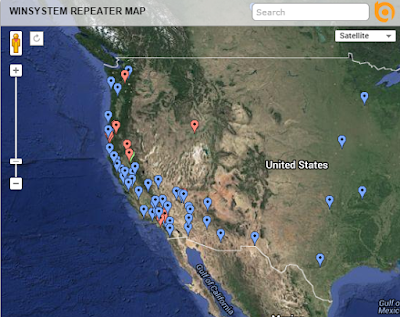 The WIN System is a series of 71
linked, or Intertied repeaters, most are 440, or UHF repeaters, but we
have some 2-meter and 220 repeaters as well, that cover a great deal of
California, 16 States, and four Countries around the world. The WIN
System is owned and operated by Shorty, K6JSI,
with a lot of help from the faithful WIN
System membership.
The membership is what makes the WIN System great! We are honored to have a very diverse cross-section of the ham radio community on our System. It makes for some very interesting conversation. Everything from technical talks to comedy can be heard on the WIN System.

The WIN System started in the San Diego area in 1990, and moved into the Imperial Valley/South-West Arizona area, then the Los Angeles area, then the Southern/Central San Joaquin Valley area.
What is Amateur Radio?

What is Amateur Radio?
If you were to ask a dozen different amateurs what ham radio meant to them chances are you would get 12 different answers. Radio amateurs have discovered a richly rewarding high-tech hobby that has many different appeals to different people. Whether it is the ability to talk to local friends over the radio waves using a hand-held transceiver (HT), communicating digitally with packet radio to exchange personal messages or vital information in an emergency, talking to other hams anywhere in the world, or engaging in contests with other Radio Amateurs over the airwaves there is something for everyone. The section What Hams Do gets into more detail about these activities.
Amateurs or Hams?
Amateurs are often affectionately called hams or ham radio operators and frequently the public is more familiar with this term than with the legal term Radio Amateur. The source of the name ham is not known but it has been around almost from the beginning of amateur radio radio in the early 1900s. The name amateur has nothing to do with skill or knowledge but rather implies that ham radio cannot be used for commercial or revenue generating purposes. It is truly a hobby but often one that makes a difference especially in emergency or disaster situations.
What Duplexers Do In Repeaters
What Repeater Duplex Filters Need to Do
A basic intro to the four types of filters, and then a discussion of duplex filtering and what they do for repeaters.
More --->>
A basic intro to the four types of filters, and then a discussion of duplex filtering and what they do for repeaters.
More --->>
HAM Radio Phonetic Alphabet
Phonetic Alphabet
A number of phonetic alphabets exist. The NATO version is most common and can be considered to be the "international" phonetic alphabet.| Letter | Code word | Pronunciation |
|---|---|---|
| A | Alpha | AL FAH |
| B | Bravo | BRAH VOH |
| C | Charlie | CHAR LEE |
| D | Delta | DELL TAH |
| E | Echo | ECK OH |
| F | Foxtrot | FOKS TROT |
| G | Golf | GAHLF |
| H | Hotel | HO TELL |
| I | India | IN DEE AH |
| J | Juliet | JEW LEE ETT |
| K | Kilo | KEY LOH |
| L | Lima | LEE MAH |
| M | Mike | MIKE |
| N | November | NO VEM BER |
| O | Oscar | OSS CAH |
| P | Papa | PAH PAH |
| Q | Quebec | KEH BECK |
| R | Romeo | ROW ME OH
|
Repeater Council Repeater - Coordination - Committees and Contact Persons
Repeater Committees and Contact Persons
Contact us by Postal Mail:

Affiliated
W.N.Y.S.O.R.C.
34 Manning Crescent
Newmarket
Ontario L3Y 6H4
Providing frequency coordination of analog and digital Amateur Radio Services in all, or portions of, 10 western counties in the State of New York (USA) and in all, or portions of, 31 counties/regions in the Province of Ontario (Canada).
How do I get a coordinated frequency pair assigned for my repeater
How do I get a coordinated frequency pair assigned for my repeater.
I am thinking about putting up a 70cm repeater up on my High School, where they have a very tall roof.
By the time It is ready to put it up, I want to make sure a frequency pair is reserved for the repeater.
Who do I contact / where can I get a frequency coordinated for the repeater?
That may require some effort by your club to check all the coordinated repeaters to see which are still up and running. It is not unusual to see repeaters still registered long after they have gone of the air. If that is the case you should be able to register that previously used frequency pair for your club repeater (attempt to contact the registered owner of the former repeater to see whether it is permanently gone or just off the air for maintenance/repairs).
Even if all the repeaters in the region are still operational (just not used very much), you may still be able to get coordination for your club repeater but it will take more effort. You need to plot the reach of your planned repeater (coverage maps) and then show that it doesn't overlap with any other repeaters sharing the same frequency pair you are applying for.
Your regional repeater coordination group should have guidelines for that process (which may involve running your repeater uncoordinated for some period and checking for interference reports).
What is The Best HF HAM Radio Antenna
What is the best all around hf antenna you can get ??
Does "best" in this context mean the most expensive antenna available?
Does "best" in this context mean the easiest antenna to install?
Does "best" in this context mean you have unlimited space and the size of the antenna is not a factor?
Does "best" mean you are only concerned with performance?
Does "best" mean you are only concerned with how many bands the antenna will function?
Does "best" mean you have a 90 foot tower or does "best" mean you are limited to using 2 trees in the backyard?
...Do you see the problem with "best"?
AOR AR-DV1 Wideband Communications Receiver
AOR AR-DV1 Wideband Communications Receiver
The DV1 is the first radio that provides decoding of many of the digital formats which no other scanner is able to receive, including:

- MotoTrbo ™
- DMR ™
- dPMR ™
- NXDN ™
as well as numerous amateur radio digital formats from Yaesu, Kenwood, Icom and Alinco. The radio will also decode APCO-25 Phase I digital as well as conventional analog traffic. (The receiver does not trunk). MotoTrbo systems are now used by public safety agencies and business around the country and the world. NXDN is used by public safety as well as railroads around the nation.
This radio is a huge breakthrough and we hope you’ll join us at Dayton this year to see the receiver in action, live at our booth. We also will have a small stock available for purchase at the show. Gommert Buysen of BuTel Software will once again be at our booth as well

ONLINE INTERNET ANONYMITY BOX PUTS YOU A MILE AWAY FROM YOUR IP ADDRESS

In the game of anonymity-versus-surveillance online, the discovery of the user’s IP address usually means game over. But if Ben Caudill has his way, a network snoop who successfully hunts a user through layers of proxy connections to a final IP address would be met
HAM Radio Morse Code
Morse Code
Main articles: morse code, Wikipedia:Morse codeMorse code is a way to encode text through the generation of a carrier wave (CW). It is used to communicate over long distances or with low power (QRP).
You do not need to learn morse code to obtain a radio license or operate an amateur radio station anymore.
The code is composed of 5 elements:
- short mark, dot or 'dit' (·) — one unit long
- longer mark, dash or 'dah' (–) — three units long
- intra-character gap (between the dots and dashes within a character) — one unit long
- short gap (between letters) — three units long
- medium gap (between words) — seven units long
| Character | Code | Character | Code | Character | Code | Character | Code | Character | Code | Character | Code |
|---|---|---|---|---|---|---|---|---|---|---|---|
| A | · — | J | · — — — | S | · · · | 1 | · — — — — | . | · — · — · — | : | — — — · · · |
| B | — · · · | K | — · — | T | — | 2 | · · — — — | , | — — · · — — | ; | — · — · — · |
| C | — · — · | L | · — · · | U | · · — | 3 | · · · — — | ? | · · — — · · | = | — · · · — |
| D | — · · | M | — — | V | · · · — | 4 | · · · · — | '' | · — — — — · | + | · — · — · |
| E | · | N | — · | W | · — — | 5 | · · · · · | ! | — · — · — — | - | — · · · · — |
| F | · · — · | O | — — — | X | — · · — | 6 | — · · · · | / | — · · — · | _ | · · — — · — |
| G | — — · | P | · — — · | Y | — · — — | 7 | — — · · · | ( | — · — — · | " | · — · · — · |
| H | · · · · | Q | — — · — | Z | — — · · | 8 | — — — · · | ) | — · — — · — | $ | · · · — · · — |
| I | · · | R | · — · | 0 | — — — — — | 9 | — — — — · | & | · — · · · | @ | · — — · — · |
HAM radio hamspeak
Amateur radio | HAM radio hamspeak
If you've heard somebody use terminology you're not familiar with, look it up here and you're likely to find the definition. If you don't find it, contact us and we will consider adding it to the list.
Search Tip: Use the "Find" feature of your browser to search for the occurrence of a particular word. Most popular browsers such as Microsoft's Internet Explorer and Netscape's Navigator allow you to access the "Find" feature by pressing Ctrl-F.
0-9|A|B|C|D|E|F|G|H|I|J|K|L|M|N|O|P|Q|R|S|T|U|V|W|X|Y|Z
| ? | "Slashed Zero" - distinguishes a ZERO from the letter "O". Intended to resolve ambiguity in callsigns like ""W?OF". Not needed for callsigns like "W0RK". Can be produced by pressing Alt?216 on your PC keyboard (Note: you must use the numeric keypad, not the numbers across the top row of the keyboard. This method should work in most PC-based editors such as e-mail clients, word processors, etc.) |
| 73 | "Best Regards" (Source: "Morse Code: The Essential Language", 2nd Ed., ARRL Publishing) |
| 807 | An old glass vacuum tube, several inches tall and around. Also, slang for a beer, as in "there's nothing like a cold 807 on a hot Arizona afternoon" (thanks to W7QY). According to our friends in Ireland, a pint of Guinness is known as a "Black 807" (thanks to GI4FUE). |
| 88 | "Hugs" and/or "Kisses" |
| ACSB | Amplitude Compandored Sideband modulation |
| AGC | "Automatic Gain Control"; a circuit in a radio which automatically adjusts the overall gain of the receiver |
| A-Index | Linear index for measuring the disturbance level in the earth's magnetic field. The index is defined over a period of one day (Courtesy of IPS Radio and Space Services, Sydney, Australia). |
| AM | "Amplitude Modulation"; slang often used is "Ancient Modulation" (courtesy of VE3FFK). |
| AMTOR | "Automatic Teleprinting Over Radio"; popular digital mode on HF |
| Antenna Gain | The ratio of the power required at the input of a loss-free reference antenna to the power supplied to the input of the given antenna to produce, in a given direction, the same field strength at the same distance (def. courtesy of Telecom Glossary 2000) |
| Antenna Party | A long-standing tradition among hams where several gather to assist a fellow ham in mounting antennas and/or towers. Often accompanied by malt consumables and lies AFTER the tower and the antennas are up and working...well, the consumables anyway (thanks to WD5CTQ). |
| AOS | "Acquisition of Signal" from a satellite; occurs when the satellite becomes "visible" to the antenna as it comes up from the horizon. |
| APRS | Automatic Packet Reporting System (Uses GPS + Packet Radio) |
| ARRL | "American Radio Relay League"; A U.S.-based organization which exists to support Amateur Radio. For more information, please visit http://www.arrl.org. |
| ATV | "Amateur
Television"; typically found on the 430 MHz and 1.2 GHz bands; see
http://www.hampubs.com/atv.htm for more information (thanks to KG4LXA for the suggested link).
|
DMR for EmComm
The CT ARES DMR microwave network has been down for at least four weeks. This is public knowledge and has been public knowledge since the DMR connectivity was taken down as the result of an on-going reconfiguration of the microwave network. Public knowledge as in:
- CT ARES leadership has been issuing approximately weekly updates on the network's status to all CT ARES members
- The fact that it is down has appeared in local news media
- It has NOT been tested on Sunday after the regular analog CT ARES net since it was brought down back in late April
- It has NOT been used daily for general COMMS since it was brought down back in late April
A few of the CT ARES DMR repeaters have been brought back onto the microwave network, but it is slow going for various reasons.
In the interim, the CT ARES DMR repeaters that are internet connected remain in network operations, as are those that have been transferred over to internet connection until the microwave network is fully operational. In addition, there are a number of internet-connected MARC repeaters in the state.
*****
As to asking "... why wouldn't you use DMR for emcomm ...", that's like asking "... why wouldn't you use Echolink or D-Star for emcomm ..."
The answer is: with few exceptions, DMR repeaters (like Echolink and D-Star) are internet linked. If internet is down within an area, then DMR linkage is almost undoubtedly down. If internet is down within an area, then Echolink and D-Star linkage is almost undoubtedly down.
If the internet is not down within the area, why would "they" need ham radio for communications across the area?
The goal of the CT ARES DMR microwave network is to have a statewide network that is not dependent on the internet, but rather runs on a high availability, redundant, and hardened network.